I got two phone calls in the twenty-four hours between the mornings of July 4th and 5th, 2023.
The first one was around 9:30am on the glorious Fourth, a rare day off for me during which I’d vowed to do nothing for a change. No work, no gigs, no being tempted by the treacherous apple of rock-bottom estate sale organs like I’d succumbed to the weekend prior—though I was grateful for the $200 B-3-equivalent that Tony had found me. No, today would just be an evening’s cozy get-together high up in Canoga Park, as was tradition. So when Jeff, the more sane and lucrative half of LA Rock n’ Roll Rescue, rang, I was hesitant and half-asleep, but a whisper in the wind, an unusual vibration way out in the ether told me to pick up.
“Dawg. This old guy just called and said he has a Hammond B-3 he’s getting rid of for free. Let’s go get it.”
Most folks, including 17-year-old me, would have jumped up at such a proclamation. The days of the free B-3 should have ended circa 1992, when people were at last snapping out of their DX-7 dopesickness and getting back to what really mattered: rose-tinted nostalgia, the fetishization of vintage, and chiropractor bills. I’m from Massachusetts, where the state bird is cynicism, and this all seemed a bit far-fetched. It probably wasn’t a B-3. Everyone thinks every Hammond organ is a B-3. More likely it was a C-2, a BV, hell, it could even be a spinet or not a tonewheel model at all. If by some chance it was a ‘3, it would probably be thrashed, or a lousy year, or both. Was there a Leslie with it? No. Were there any pictures of it? No. Was I going to stay home and chance it? No.
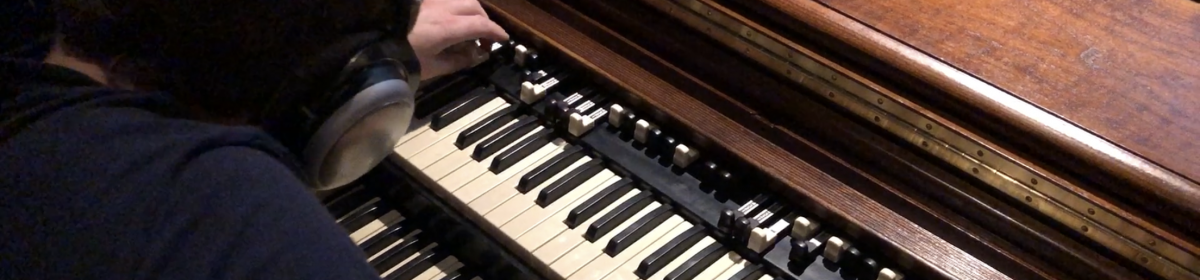
I picked up Jeff in Fat Amy and we drove down to Crenshaw and met Norman and his wife. He was an old road dog, a retired working cat in his autumn years paring down his belongings. His genuine smile and generous spirit reminded me of my father. The organ was stashed under a tarp in the garage and looked like it hadn’t been seen by human eyes since Reagan. I pulled off the tarp with some trepidation. It was, in fact, a B-3, but it was, however, thrashed. As I inspected it closer and overlooked the well-roaded cabinet, though, it was clear that it was fully intact, and was built at the very tail end of the “good” years before the designs and manufacturing started to go pear-shaped. Okay, it was worth the trip. What’s more, surprisingly, this would be my first actual B-3. I’ve owned several Hammond organs, many of which were mechanical equivalents to the famous model—C-3s, various flavors of A-100—but never that particular model. Especially for free, this was a good find.
Norman was awed by the remote-controlled winch system I built into the truck that allowed me to load the organ without any assistance. In it went, to his beaming delight. He called his wife over to see as the whining winch tugged the tired Hammond up the ramp and into the Transit’s cargo hold. Jeff and I thanked him profusely for his generosity, and promised that the organ would be well cared for and used properly. After 25 years of making his living with it, Norman was happy to let it go to someone who would give it the attention it deserved. We were on our way.
The second phone call came at 5:10am the next morning. It was my younger sister. My father had passed away.
That loping buzz of the phone on the nightstand and the simultaneous insistent doodly cheerful ringtone of the iPad amid a bleary post-REM sleep in that dark blue hour told me everything before I even answered. This was exactly the call I’d been dreading, at exactly the time I imagined I’d get it. My older sister wailed in the background. First responders were there. He was still in his bed. Still warm. Despite years of mounting pulmonary struggle, he’d gone peacefully, in his sleep, in the home he built, with his family—minus me—there. He’d had a great Fourth, one last one for old times’ sake. It was just about all we could have hoped for at that point. I spent that day stumbling between uncontrollable sobbing, talking on the phone, and a zombie fugue state, with a smattering of Cape Cod chip eating thrown in so I didn’t completely shut down.
In the summer of 1999, in the fast-fading astronomical twilight of what might be called the Good Old Days on Martha’s Vineyard, I was 15 years old. Mom was hatching a plan. Dr. John, Mac Rebennack, known as the Nite Tripper with his satchel of gris-gris in his hand, was coming to town. He was playing the legendary Hot Tin Roof, today but a wild smoky crimson memory with a boutique artisanal grocery store occupying its erstwhile walls. Back then, though, The Roof was still clinging to driftwood and kicking gamely. So she pulled a few strings with their old friend Bucko dello Russo who ran the joint, and got permission for me to go with Dad—on the conditions that I’d be accompanied by him at all times, and would stay the fuck away from the bar.
Dad and I made our way to the foot of the stage as soon as we got inside. There in the front row along with the island’s other pianisti vying for a good look at the Doctor’s hands—Jeremy Berlin, David Stanwood, et alia—I’d come to go to school. The band kicked in with the classic New Orleans Iko-Iko groove, building the anticipation, until finally, the Last of the Best, the Gris-Gris Man himself emerged, crooked cane in hand, and sat at the piano. The lesson began.
I wish I could remember what songs Mac played that night, but my eyes never wandered. There was, however, something I needed to know. I asked Dad, an old 60s rocker himself who bore witness to all the greats in their absolute heydays.
“What is that other keyboard he’s playing?”
“That’s a Hammond B-3 organ.”
“And what’s that other box next to it?”
“That’s the Leslie speaker.”
From that point on, man, that was it. This was everything. It’s a wonder I got into any sort of college at all, let alone one like Bates, since most of my time in high school not spent in class or playing music or sleeping was spent crawling the classic internet, trying to learn every morsel of information on every screw and wire and shaft inside a Hammond and Leslie. I daydreamed of owning one, of playing one, of getting inside one and knowing every inch of one. It was all-consuming. Ask anyone who knew me back then. Whiteboards and textbooks with “Hammond B-3” scrawled on them told people I’d been there. These two devices coming together as one instrument unlike any other was a melding of art and science, engineering and emotion almost too perfect for us lousy fallible humans to deserve.
The last time I saw my dad was a month before he died, when I came home to visit and help take care of things around the house. We spent every night that week watching The Twilight Zone together, reminiscent of younger days when we’d watch everything from Star Trek: The Next Generation to Eerie, Indiana to Sanford and Son to NOVA together (that last one he’d go on to star in an episode of for his selfless and celebrated work to save the Gay Head Lighthouse). More than once, I was ready to go to sleep, but stopped myself and stayed longer. Part of me felt like this would be the last father-son time we’d have. I’d take care of his needs, get him his water, get him his tea. Make sure his oxygen hoses were sorted, wrapped over-under. Hug him goodnight.
The morning I left the island, he called me as I stood in line for the Steamship. He wanted to make sure I knew how proud he was of me. That he was my biggest fan. I thought back to every school play he came to, every Ag Fair and Katharine Cornell Theatre blowout with John Barleycorn & the Social Drinkers and Willy Mason, my days at The Roof in the Battle of the Bands or with Kate Taylor playing that same B-3 Dr. John played, him casually turning up at the sloppy Animal House shitshows of dorm parties my drunken college band The Nancies would play during Parents’ Weekends, coming all the way to see me with Patrick Droney at huge venues like Montreal Jazz Festival, the Atlantic City House of Blues and the New Jersey Performing Arts Center supporting B.B. King, showing up by surprise in costume at Great Scott in Boston for Vostok 4’s Talking Heads Halloween show. He was there for it all. He was my biggest fan, after all. His sweet paternal voice wavered. I started to lose it on the ferry dock. I told him I loved him and I’d see him in August. I kind of knew I wouldn’t. So did he.
I came back to the island the day after he passed and we all took care of business and one another. We went to the beach almost daily. Went to the lighthouse at sunset. Had lobsters from Stanley’s, pizza from the Chilmark Store. Played backyard baseball with the kids. Stargazed with Kevin’s fancy new smart telescope. Went to the Thursday night hootenanny up at the cliffs. All the things he would have wanted out of a summer.
I went down into his shop to try and make sense of his decades of accumulated matter. What was trash? What was still useful? What would I keep, what would go to a deserving third party? How do you even begin to ascribe values to the material relics of such an estimable man who kept everything? I made myself a pile of what I wanted and would use in my work to imbue it with his spirit. His Makita circular saws, the Bosch sander and router, my childhood favorite the old Lamello biscuit joiner, scads of small hand tools, and the big stuff like his miter saw, table saw, and circa 1977 Powermatic jointer. I made another pile of things other folks ought to have. But so much had to go. I went down and borrowed my old friend Big Red from the John Early workshop, backed it up to the basement doors, plucked up my resolve, and started tossing. Wood from when the house was built. Sawhorses older than me. Nails, screws. Old chairs. iPod speakers. An old Hammond tone cabinet of mine. More wood. So much god damn wood. I stopped tossing when the pile started cresting higher than the top of Red’s sides and went to the transfer station. 1,840 pounds of stuff came out the back of that stakebed. I cried on the drive back. The last time I’d driven that truck was with Dad.
Like I said, there was an unconscious reason I answered that phone call from Jeff on the morning of the 4th. It was Dad’s last full day on Earth, a date that traditionally was a red-letter one for us and our up-island cabal of way gone billion-year-old carbon hippies to stage grand subversive celebrations of this horrid American glory, a day he loved, and he had one last gift to give me before he left. He was the one who first taught me what these miraculous inimitable machines were, and through some unutterable cosmic back channel, some divine trans-dimensional force—I don’t know, I’m not good with the woowoo crystal stuff— he put that old B-3 into my hands. And everything, as they say, was everything.
Donations in Leonard Butler’s honor to preserve the Gay Head Light may be sent via check, made out to the town of Aquinnah, and mailed to: Town of Aquinnah, Attn: Lighthouse Keeper, 955 State Road, Aquinnah, MA 02535. “In memory of Len Butler” should be written in the check memo.

 Maxwell Butler